


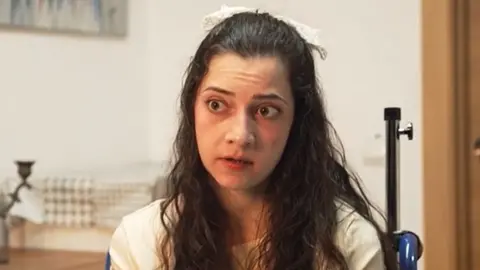
 Y Ahora Sonsoles (Atresmedia Television)
Warning: This story contains references to sexual violence and suicide.
The passing by euthanasia of a twenty-five-year-old Spanish woman following a protracted legal battle with her father has triggered debate about the responsibility of the government in looking after her and why it took so long to implement her desire to die.
Noelia Castillo, who had been left paralyzed due to injuries sustained when she tried to end her life in 2022, died on Thursday evening at a Barcelona medical center.
The Catalan regional government had granted her the right to euthanasia in the year 2024.
However, the process was suspended at the last moment following legal objections raised by her father, supported by the campaign group Christian Lawyers.
The situation has garnered significant attention in the country, with the legal group attempting to prevent her death until the very end.
After an 18-month court fight, the European Court of Human Rights (ECHR) ruled this week in Noelia Castillo's favor and her passing was eventually verified in the late hours on Thursday.
A Difficult History
She had passed much of her early years in state institutions and had described the impact on her psychological well-being of her parent's problems with alcohol and of being assaulted by an ex-boyfriend and also by a number of men in a club.
In a TV interview this week, she said nobody in her immediate family had backed her choice to die by assisted death, and her father "hasn't respected my decision and never would".
"I wish to pass in calm now and stop suffering," she told a television channel the day before she died.
Her mother had disagreed with her choice but was with her at the hospital.
A ex-friend of Castillo, a friend, tried to enter the hospital to persuade her to change her mind, but told media that police had prevented her from entering.
A UK musician living in the country issued an appeal to Castillo via social media to think again and offered to pay her medical costs until she felt "in a position to make this choice from a slightly more tranquil place".
Institutional Failures Questioned
Christian Lawyers argued that her case had underlined failures in her support.
"For a young woman who obviously has had a extremely difficult life, which we all are sorry for, the sole option that could be offered to her by the public health system is death," said a spokesperson for the organization.
The opposition right-leaning party, which voted against a 2021 euthanasia law, had a comparable response.
"State bodies that should have protected Noelia failed her," wrote the group's leader on an online platform. He continued: "I decline to accept that the state did not have the means to give her proper support."
In a declaration, the Catholic Church, said that her story "reflects an accumulation of individual pain and systemic letdowns".
Legal Hurdles and Backing
However, other observers have taken issue with the fact that her desires were thwarted by legal obstacles put in her way by her father and the legal group.
"The desire to put an end to her pain by using the right to euthanasia was… undermined by a legal crusade that inflicted almost two years of suffering to her life," noted a progressive publication in an opinion piece.
A member of Congress for a left-wing platform remarked that "Nineteen physicians have endorsed her decision and we should be accepting of it", while adding that it was a "deeply complex" issue.
The Country's Assisted Dying Legislation
Spain is one of a small number of European nations, including the Holland, Belgium and Luxembourg, that have enacted regulations permitting euthanasia to be performed by doctors.
Under Spain's 2021 legislation, any Spanish person over 18 requesting euthanasia must be suffering from an untreatable illness or "serious, chronic and disabling condition" and their decision must be taken without coercion.
The request needs to have been expressed twice in written form and has to be validated by a physician who then consults with another medical professional.
The request then goes to a Guarantee and Evaluation Commission, which has the task of assessing if the requirements have been fulfilled.
According to official data, four hundred and twenty-six applications for assisted dying were granted in 2024, the most recently completed period for which information is available. This was the first time that a request went to court for a judge to decide.


